People visiting Sundarbans for the first time will inevitably throw the question, “What can I expect to see in Sundarbans?” My spontaneous answer will always be, “Kingfishers, what else!” Somewhat disappointed, they enquire about tigers and other charismatic creatures of the mangrove forests. I tell them that the Indian Sundarbans has a huge diversity of flora and fauna. If luck favours, they may see a tiger, but at the end of the trip, what will create a lasting impression on their mind will be the kingfishers. Unlike other fauna, kingfishers are abundant in the brackish waters of Sundarbans, and their diversity is unmatched by any other landscape. Eight species of kingfishers have been recorded from the Indian Sundarbans, out of India’s total of twelve kingfisher species. In this article, “Sundarbans” will refer to the Indian Sundarbans.
Perhaps, the most abundant kingfisher(as per my observations) in the Sundarbans is the Collared Kingfisher Todiramphus chloris. The unusual bluish-green Kingfisher with a prominent white collar, white breasts, and white belly will likely be the first kingfisher you will spot in Sundarbans, irrespective of the season. They can be found in the mangrove patches girdling the village islands and also in the forests. Small crabs picked up from the mangrove mudflats are their favourite food, followed by shrimps and mudskippers. Collared Kingfishers will inevitably have
some mud stuck to their beak. They become vocal and active from the end of February to March when courtship begins. During this period, they are often found in pairs and perch on the higher branches, calling out to their mate. I once had the privilege to witness the courtship of a Collared Kingfisher pair from a close distance. The male offered a small fish as a nuptial gift (common behaviour), but the female made a great fuss, flitting from one branch to another, with the male in its pursuit. Phew !! Passing on genes takes a lot of effort for the males of most species.
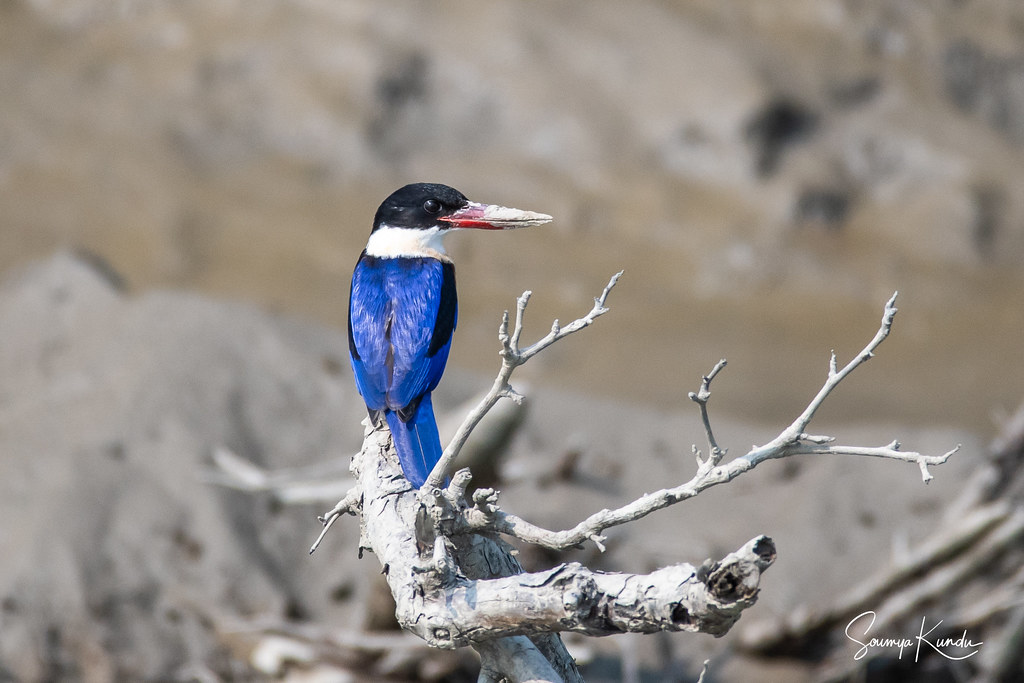
The Black-capped Kingfisher Halcyon pileata is the only migratory kingfisher of the Indian Sundarbans. The species migrates to the Indian Sundarbans from Southeast Asia. They enter around late September and remain in the Sundarbans till March. During this period, this handsome kingfisher with its jet-black head, red beak, white collar, and deep blue-black wings dominates the landscape, often chasing away the Collared Kingfishers from their immediate vicinity. Their vibrant, eye-catching colours beautifully stand out against the drab mangrove mudflats. While looking for crabs, they perch quite close to the ground, often sitting on twigs just a few inches above the mudflats. Despite their easy sightings in winters and apparent high density in Sundarbans, this species is in the vulnerable category of the IUCN Red List with a rapidly declining population. Individuals get disturbed
very easily by human presence.
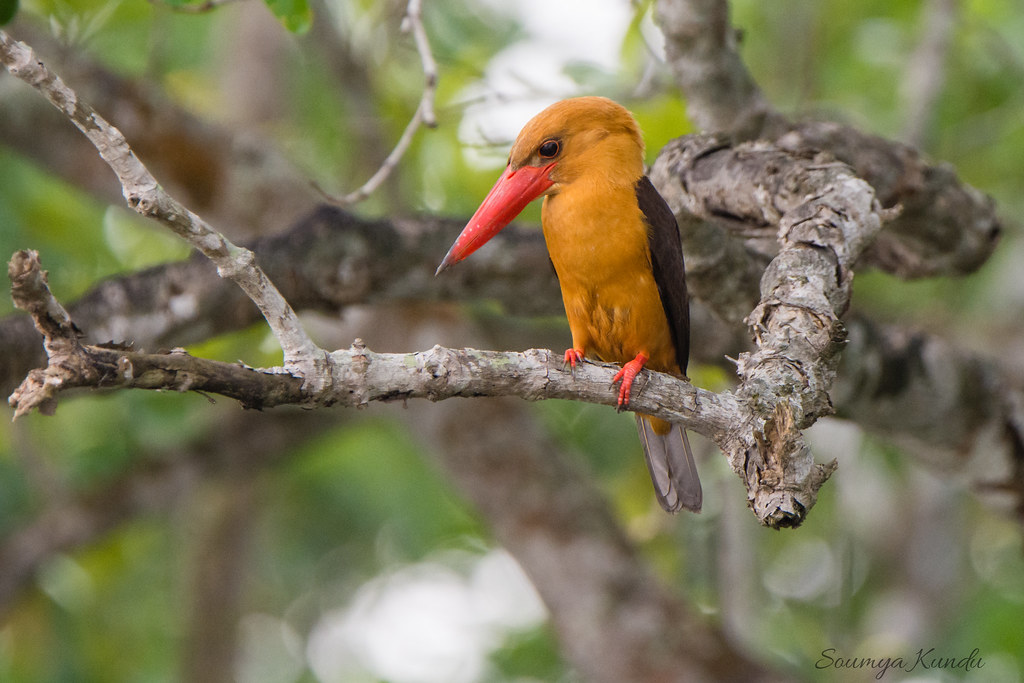
The Brown-winged Kingfisher Pelargopsis amauroptera is a resident of the Sundarbans and is not known to migrate. However, its movement and feeding activity are rarely recorded except for the winters when it can be seen perched inside the foliage of large mangroves, situated mostly at the entrance of the creeks and sometimes on river banks. Belonging to the Pelargopsis (bill like a stork) genus, their massive size, enormous red bill, and habits resemble those of the Stork-billed Kingfisher. They track fish while remaining concealed within the foliage (much like the Stork-billed Kingfishers), finally diving into the river water. It also takes crabs. When perched, the orange head, deep brown wings, and the massive red bill and red feet are all you can see. As soon as it takes off, it reveals a beautiful blue colour at the rump. Most individuals are extremely bold, often ignoring humans and large motorised boats.
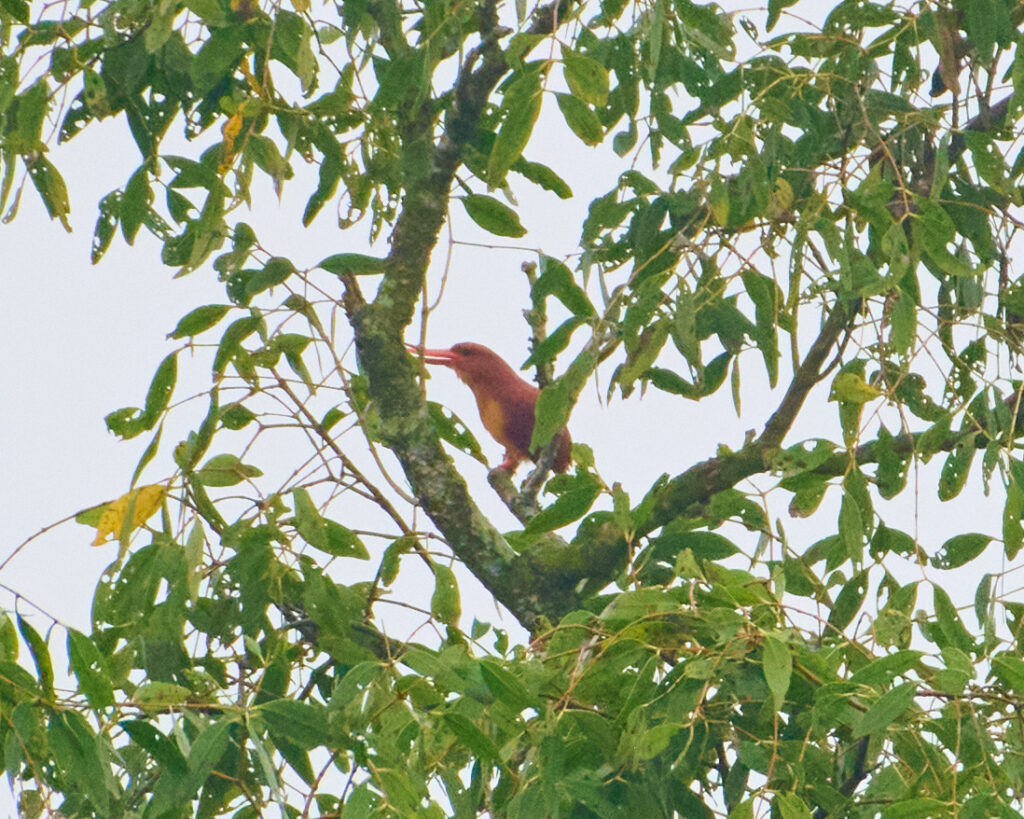
The most coveted kingfisher of the Sundarbans is undoubtedly the Ruddy Kingfisher Halcyon coromanda, another resident species. It strictly follows the principle of “less the sighting, more the charisma”, making only brief appearances during the monsoon months of July and August, when it breeds. Driven by the need to find a mate and to drive away the competitors, it emerges from the deep woods and can be seen perched on very tall trees, often calling repetitively early in the morning. It vanishes back into the forest even before the monsoon retreats. Those fortunate enough to catch a glimpse remember its red bill, orange head, and the unusual rufous-chestnut upperparts, which look almost reddish from a distance. This kingfisher can in no way be confused with the Brown-winged Kingfisher.
The Pied Kingfisher Ceryle rudis is a handsome resident kingfisher dressed up in a tuxedo. Like most other kingfishers, it builds meter-long tunnels on the banks of the rivers to lay its eggs. The male and female of this species are easily distinguishable, and the pair can often be spotted together, flying or perching on dry twigs. It has the unique ability among the kingfishers to hover for prolonged periods above the prey before diving vertically into the water. While most other kingfishers would need a perch to track their prey, this kingfisher pulls out its chair out of the thin air. The species is common both in villages and inside the forest.
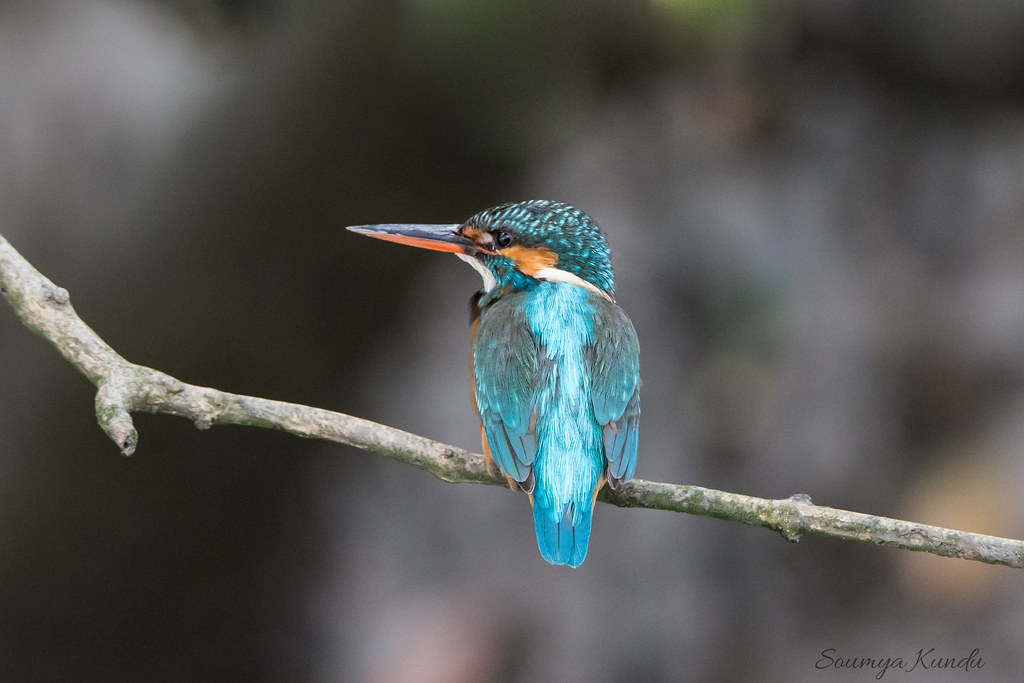
As winter approaches, all low-height perches above the surface of the river water are bedecked with tiny blobs of vibrant blue with shimmering dots. These are the Common Kingfishers Alcedo atthis, another resident species and the smallest among the kingfishers. It prefers the village ponds for most of the year but moves in large numbers into the forest channels with the onset of winter. This may be due to the calm rivers and better visibility to greater depths in the waters (due to less mud) during the cold months. The species exhibits sexual dimorphism (hint: the beak). It catches mostly small fish.
The Stork-billed Kingfisher Pelargopsis capensis is not a typical kingfisher of the Sundarbans. Though sighted at times inside the forest, it probably feels more at ease inside the villages of Sundarbans. Sighting of the species inside the forests and mangroves is not very common, though the species is widespread in Bengal.
The ubiquitous kingfisher of Bengal and its state bird, the White-throated Kingfisher Halcyon smyrnensis, maintains its dominance in Sundarbans. It is common both in the villages and in the forest.
You may visit Sundarbans for the tiger, but you are bound to fall in love with its kingfishers, and if you love kingfishers, then there is no other landscape that can be more rewarding than the Sundarbans.
[Published in Fantail, July-September 2025]
Leave a Reply